Sunday
02 August, 2026
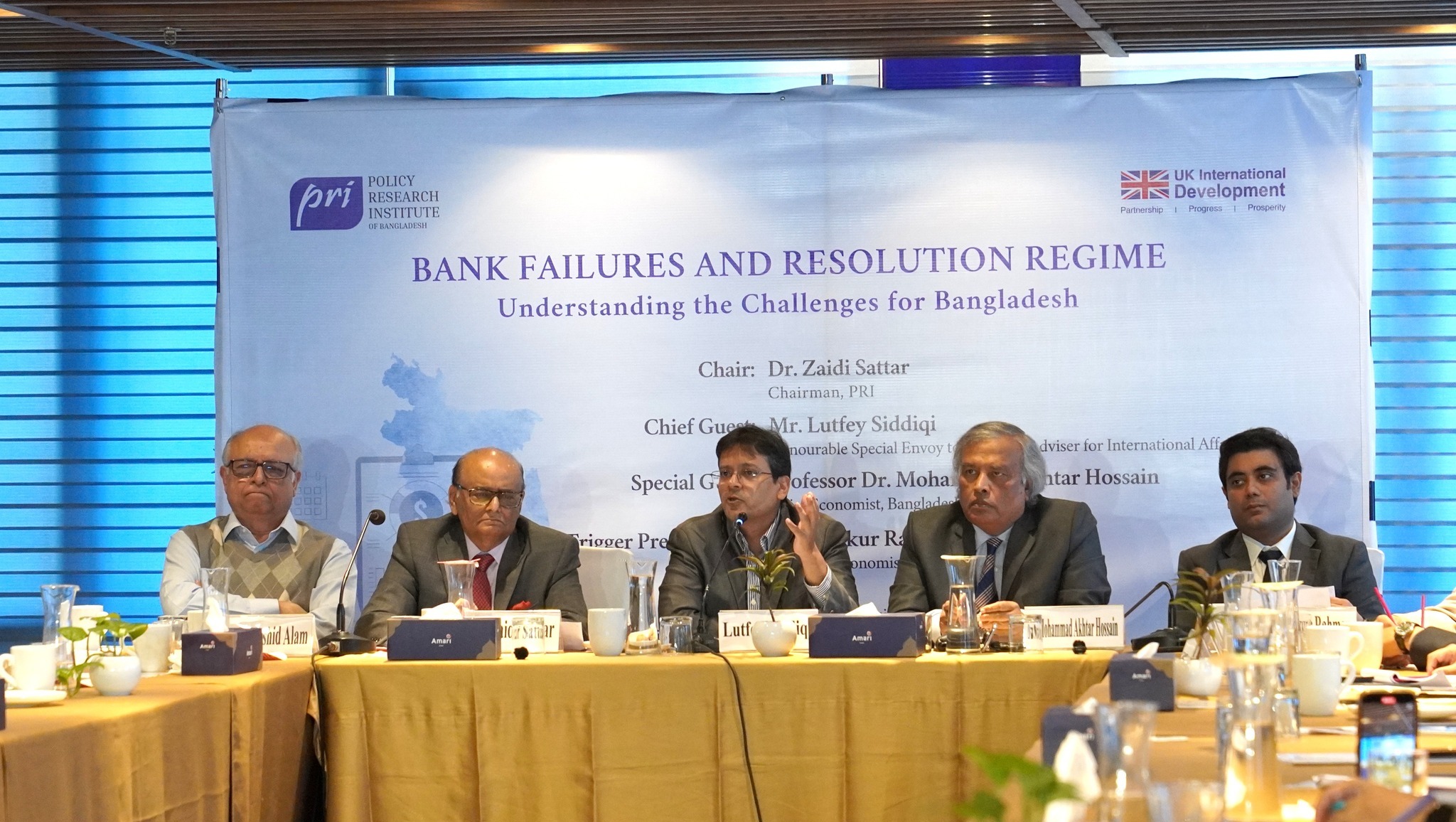
DHAKA, Dec 11, 2025 (BSS) - The Policy Research Institute of Bangladesh (PRI), with support from the Foreign, Commonwealth & Development Office (FCDO), successfully hosted a high-level roundtable discussion today titled "Bank Failures and Resolution Regime: Understanding the Challenges for Bangladesh" at a hotel in the capital.
Lutfey Siddiqi, Special Envoy to the Chief Adviser on International Affairs, attended the event as the chief guest.
Emphasizing the urgency of reform, Lutfey Siddiqi stated, "If the banking sector continues with business as usual, nothing will change. Ensuring good governance-regardless of which political party forms the government-is essential."
A trigger presentation was delivered by Dr. Ashikur Rahman, Principal Economist at PRI, who mentioned, "Passing the Banking Resolution Ordinance is only half the job. What must follow now is a serious investment in the processes, systems, and institutional capacities that will allow Bangladesh Bank and the financial sector to actually implement the resolution regime."
He said without the ability to execute orderly resolutions, manage failing banks efficiently, and protect depositors while minimising systemic risks, the Ordinance will remain a promise on paper.
He also said the real task ahead is building the operational muscle, supervisory tools, valuation expertise, recovery mechanisms, and clear decision protocols that can restore confidence and inject new energy into Bangladesh's financial system, said a press release.
"Only then will the Ordinance achieve its purpose: safeguarding stability and laying the foundation for a stronger, more resilient banking sector." Ashikur added.
Dr. Zaidi Sattar, Chairman of PRI, chaired the event. In his remarks he said, "The recent rise of non-performing loans to nearly 35 percent is unprecedented... requires careful analytical inquiry into how we arrived at this point,"
He said Bangladesh presents a uniquely challenging context, much like its distinctive trade policy landscape, and therefore demands its own framework for banking sector resolution.
He said the encouraging sign is that the hemorrhage within the sector has stopped, and the banking sector is seeing some light again.
"I'm hoping that the projection about growth of about 5% in the next year is likely to take place. Hope, I'm assuming that we have a nice, free, and fair election in February 2026 that would be a great gift to this nation by the Interim government, I think. And we all look forward to an elected government which also manages economic policy the way we expect it to."
Mohammad Zahir Hussain, Executive Director, Bank Resolution Department, Bangladesh Bank, and Professor Dr. Mohammad Akhtar Hossain, Chief Economist at Bangladesh Bank, attended as special guests.
Dr. Akhtar said, "Our FDI-to-GDP ratio is already very low, and the combination of high NPLs and ongoing political uncertainty is making it extremely difficult to attract foreign direct investment."
The open-floor discussion allowed participants to exchange insights on priority reforms, including the need for legislative updates, strengthened deposit protection mechanisms, and enhanced crisis preparedness.
As part of PRI's ongoing efforts to promote informed policy dialogue, the session brought together policymakers, financial sector experts, business leaders, and development partners to deliberate on the urgent need for a robust and credible bank resolution framework in Bangladesh-a key pillar for ensuring macroeconomic and financial stability in the face of rising vulnerabilities in the banking sector.