Monday
27 July, 2026
News Flash
News Flash
SATKHIRA, June 11, 2026 (BSS) - Defying conventional beliefs about grape
cultivation in Bangladesh, agricultural entrepreneur Helal Uddin has achieved
remarkable success by growing premium-quality grapes in Satkhira,
transforming a hobby into a profitable business venture.
Helal Uddin, 45, a former truck driver and son of Jinnat Molla of Labsa
Bypass Road area in Sadar upazila, began his journey into grape cultivation
three years ago after watching agricultural videos on YouTube. What started
with just two grape saplings planted in his home yard has now grown into a
thriving commercial vineyard spread across 15 kathas of leased land.
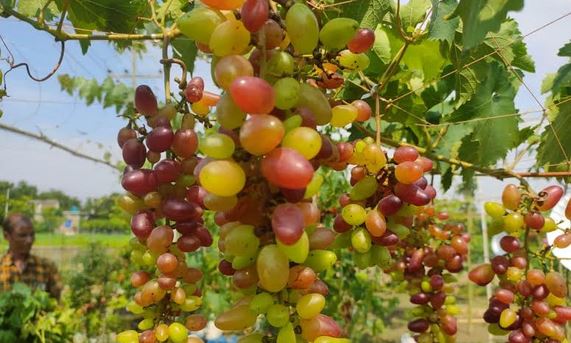
A visit to the vineyard reveals rows of grape clusters hanging from
trellises, displaying vibrant shades of red, black, green, and yellow amid
lush green foliage. The vineyard has become a local attraction, drawing
visitors from across the district eager to witness the successful cultivation
of a fruit long considered unsuitable for Bangladesh's climate.
Encouraged by the excellent yield from his initial two plants, Helal expanded
his venture and established a commercial vineyard in the Satkhira bypass
area. Today, the orchard hosts approximately 20 grape varieties originating
from countries including the United States, Russia, China, Ukraine and Italy.
Helal's success has challenged the widespread belief that grapes grown in
Bangladesh are sour. According to visitors and customers, the grapes produced
in his vineyard are exceptionally sweet and flavorful.
His wife, Aleya Begum, has played a crucial role in the venture. Recalling
the early days, she said she initially questioned her husband's decision to
spend Taka 2,000 on two grape saplings, doubting whether grapes could grow in
Bangladesh. However, their perception changed completely when the plants
produced sweet and delicious fruits.
"We now manage the vineyard together," she said. "The orchard is only nine
months old and contains 126 grape plants of different varieties.
Alhamdulillah, the grapes are producing well and are very sweet."
Helal said he leased the 15-katha plot for an annual rent of Taka 15,000 and
invested approximately Taka 350,000 to establish the vineyard. "By the grace
of Allah, the production has been very good. I have already recovered my
initial investment through the first harvest," he said.
He explained that grape cultivation requires significant investment only
during the establishment phase, while maintenance costs remain relatively low
afterward. According to him, grapevines can remain productive for 40 to 50
years and bear fruit throughout the year, with peak production occurring in
February.
"Our climate has not negatively affected grape cultivation," Helal said,
adding, "With proper variety selection and care, high-quality sweet grapes
can be produced on Bangladeshi soil. Anyone can now consider commercial grape
farming."
Buoyed by his success, he has already begun preparations to expand
cultivation onto an additional one bigha of leased land.
Visitors to the vineyard, including local youths Ekramul Islam Jony and Abir
Hossain, expressed admiration for the project. They described it as the first
commercial grape farm in Satkhira and said they were inspired to start grape
cultivation themselves after seeing the impressive results.
"The grapes here are very sweet and tasty," they said. "If the Department of
Agricultural Extension provides guidance and support, Bangladesh could not
only meet domestic demand but also export grapes in the future."
Satkhira Sadar Upazila Agriculture Officer Agriculturist Md. Monir Hossain
said that grape cultivation is a relatively new agricultural initiative in
the district. Two farmers in Satkhira Sadar and Kalaroa upazilas have already
started grape farming on a trial basis, cultivating between 20 and 80 grape
varieties, he added.
"There is significant potential for grape cultivation on the district's
fallow lands," he said.
"If we can ensure good production, we will be able to meet local demand and
market grapes across the country. Just as Satkhira's mangoes and jujubes are
renowned for their unique taste, locally grown grapes could also develop a
strong market demand," the newly-agripreneur continued.
He added that utilizing unused agricultural land for grape cultivation could
further strengthen the region's agricultural economy while creating new
employment opportunities for rural youth.
Agricultural experts believe that innovative entrepreneurs like Helal Uddin
are paving the way for agricultural diversification in Bangladesh,
demonstrating that non-traditional crops can thrive with proper management,
technology, and dedication.