Sunday
13 September, 2026
News Flash
News Flash
RAJSHAHI, Feb 23, 2026 (BSS)- Heavy rainfall in the month of Kartik last year caused severe devastation for betel leaf growers in the Rajshahi region.
The leaves began to rot. Even before that, throughout the monsoon season, farmers had faced a capital-eroding collapse in market prices. The rainfall
in Kartik was like "adding insult to injury."
However, after the national election, betel leaf prices began to rise. Farmers' economic conditions started to recover, and smiles have returned to
their faces.
The largest betel leaf market in Rajshahi is held in Mochmoil of Bagmara upazila. The market convenes every Friday and Monday.
Traders from various parts of the country purchase betel leaves here and supply them nationwide.
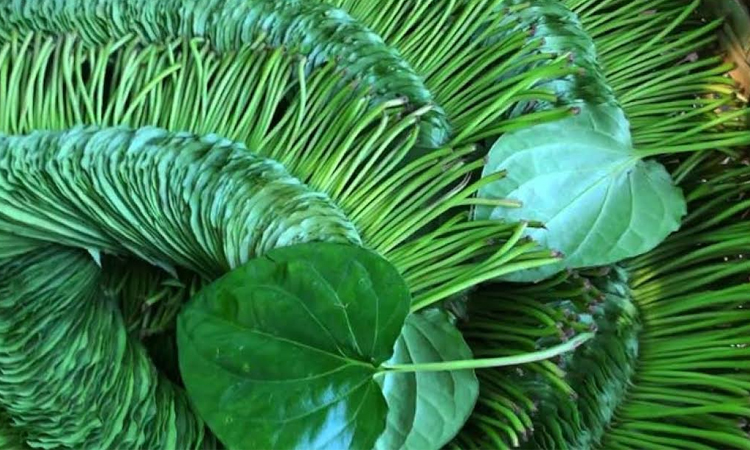
On Friday last, the finest quality one "poa" of betel leaves (32 bundles, with each bundle containing 64 leaves) was sold at Tk 5,800 at Mochmoil
market.
Medium-sized betel leaves were priced at Tk 3,000 per poa, while small-sized leaves were sold at a minimum of Tk 500 per poa.
In contrast, during last year's monsoon, the best-quality betel leaves were sold for only Tk 300 per poa.
At present, farmers are satisfied with the higher prices. Since the 13th national election, prices have been steadily rising.
Although demand usually declines during Ramadan, causing a slight drop in prices, this year even after the start of fasting, only minor fluctuations have been observed. Farmers are hopeful that prices will rise further after Ramadan.
Generally, four types of betel leaves are traded at the market: premium (sorted) leaves, medium leaves, "satta" leaves (small and slender), and ripe
or spotted leaves.
Prices vary according to type and quality, with premium leaves fetching the highest prices, followed by medium-sized leaves.
It is worth noting that Rajshahi's betel leaf is widely popular across the country for its tradition, taste, and sweetness.
Recognized as a Geographical Indication (GI) product, Rajshahi's betel leaf holds a special status.
Betel leaf has been an integral part of the Indian subcontinent's thousand-year-old tradition and social customs.
It is not merely a leaf but a symbol of hospitality, affection, and culture. Since ancient times, offering betel leaf and areca nut has been a mark of
respect and social etiquette for honoring guests.
Babu, a betel leaf grower from Haridagachhi area under Kesharhat municipality in Mohanpur upazila, said he has a betel orchard on ten kathas of land.
Prices are determined based on size and quality. He said, "Today at the local market, I sold medium-sized betel leaves at Tk 100 per bundle and large-sized
leaves at Taka 150 per bundle."
Ashraf Ali, a farmer from Bakshimail village in the same upazila, said he has a one-bigha betel orchard.
Betel leaves that were selling for Taka 80 to Taka 100 just a week ago are now selling for Taka 150.
Earlier, one poa of betel leaves was priced at around Taka 3,000; now it has risen to Taka 5,000. Another local grower, Badr Uddin Bhola, shared a similar
experience.
According to the District Department of Agricultural Extension, betel leaf has been cultivated on 4,509 hectares across nine upazilas in the district
this year, with a production target of 79,681 metric tons. In the previous season, 4,500 hectares were cultivated, yielding 77,220 metric tons.
'
Betel leaf is a major cash crop in the Rajshahi region, ranking above mango in economic importance. Rajshahi's betel leaf is also exported abroad.
On 31 August 2024, "Rajshahi's Sweet Betel Leaf" received recognition as a GI product, which stakeholders believe has further enhanced its brand value in
the market.
Each year, approximately Tk 3,500 crore worth of betel leaves are traded in Rajshahi.
Farmers and agricultural officials hope that if market prices remain stable and transportation and storage facilities improve, investment in betel leaf
cultivation will increase further, positively impacting the local economy.