Sunday
06 September, 2026
News Flash
News Flash
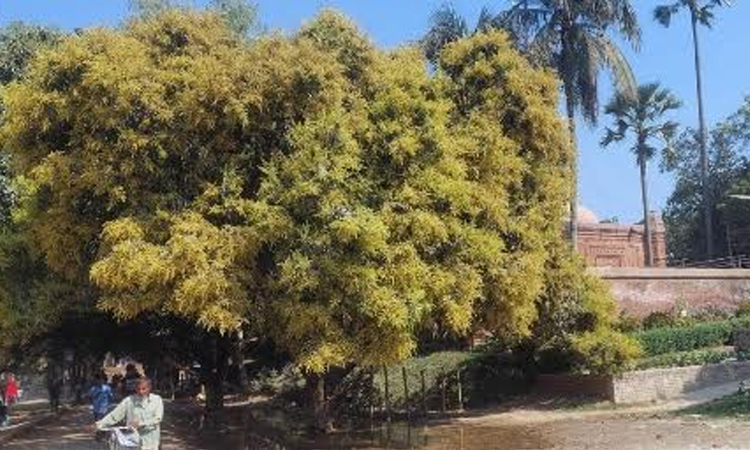
RAJSHAHI, Feb 16, 2026 (BSS)- The sweet scent of mango blossoms is now wafting through orchards across Bagha Upazila, a major mango-growing area in Rajshahi.
The aroma is soothing to the senses. Some trees have just begun to sprout small clusters of blossoms, while others are already in full bloom.
As a result, orchard owners and traders are passing busy days tending to their gardens. If the weather remains favorable, the local agricultural department is hopeful for a good harvest.
According to officials, mangoes from Bagha have been exported abroad for the past several years.
When rows of mango orchards line both sides of the roads and the topic of delicious and diverse mango varieties arises, the name Rajshahi naturally comes to mind.
Although the district is famous for mangoes, the upazilas of Bagha, Charghat, and Puthia are particularly renowned as the main mango-producing areas.
Farmers in the region said that most orchards did not produce good yields last year. This year, however, trees across all orchards are covered in full blossoms. Growers believe that, based on the current weather conditions, this season’s blossoms are better than last year’s.
Elderly residents of Bagha noted that the upazila is home to the 500-year-old historic Bagha Shahi Mosque. The mosque’s stone inscriptions bear images of mangoes, reflecting the fruit’s long-standing heritage in the area.
Built in 1523–24 by Nusrat Shah, son of Sultan Alauddin Hussain Shah, the mosque features terracotta mango motifs on its lime-and-surkhi brick inscriptions. This serves as evidence that Bagha’s reputation for mangoes dates back to ancient times.
Locals added that mango blossoms are now blooming everywhere, spreading their intoxicating fragrance and filling the air with sweetness. The orchards also herald the arrival of the honeyed month of spring.
According to the upazila agriculture department, among the nine upazilas of Rajshahi district, the combined area of mango orchards in eight upazilas is nearly equal to that of Bagha alone.
Mango is the principal cash crop here. Not only are Bagha mangoes famous nationwide, but in Dhaka markets they consistently fetch higher prices than mangoes from other districts and upazilas.
Over the past seven to eight years, mangoes from Bagha have been exported to Switzerland, Hong Kong, the Netherlands, Italy, France, and other countries around the world.
During mango season, at least 25 small and large mango markets (hats) operate in Bagha.
Major markets are held in Bagha Sadar, Monigram, Binodpur, Bausa, Arani, Pakuria, and Baneshwar in Puthia upazila. Mangoes also arrive at these markets from neighboring Charghat.
Local residents said that if the weather remains favorable until the mangoes ripen and the political situation stays peaceful, the current rate of blossoming could push mango sales beyond tens of billions of taka this season.
Among the popular varieties grown in the region are Fazli, Khirsapat, Gopalbhog, Langra, Arajom, Amrapali, and Ashwina.
In addition, there are nearly 150 varieties, including Bou-Volani, Ranipachand, Jamai Khushi, Brindaban, Lokna, Bombay Khirsa, Mohanbhog, Senri, Banana, Khirsapat, Brindabani, and Kalibhog.
Each year during mango season, the upazila provides employment for around one hundred thousand people.
Orchard owners in the region said that mango trees begin to bloom at the start of the Bengali month of Magh each year.
Accordingly, orchard owners and traders have already begun taking care of the blossoms. They believe that by the end of Falgun, the blossoms will fully develop into small fruit buds.
A local proverb says, “Mango blossoms are like fish roe—if they survive, we will see who eats how much.”
Growers estimate that even if just 25 percent of the blossoms survive, there will be a bumper harvest. Mahasin Ali, a successful mango farmer from Amodpur village, said that from blossoming to harvest, insecticides must be applied five to six times, costing between 38,000 and 45,000 taka per hectare.
Bagha Upazila Agriculture Officer Shafiullah Sultan said that scientific mango cultivation can increase production, and proper preservation, transportation, export, and marketing will ensure greater profits for farmers.
He added that due to various advisory initiatives encouraging improved cultivation and management methods, Bagha mangoes have been exported abroad for the past seven to eight years.
According to him, mango orchards in the upazila cover approximately 8,500 hectares of land.