Wednesday
26 August, 2026
News Flash
News Flash
By Md Mamun Islam
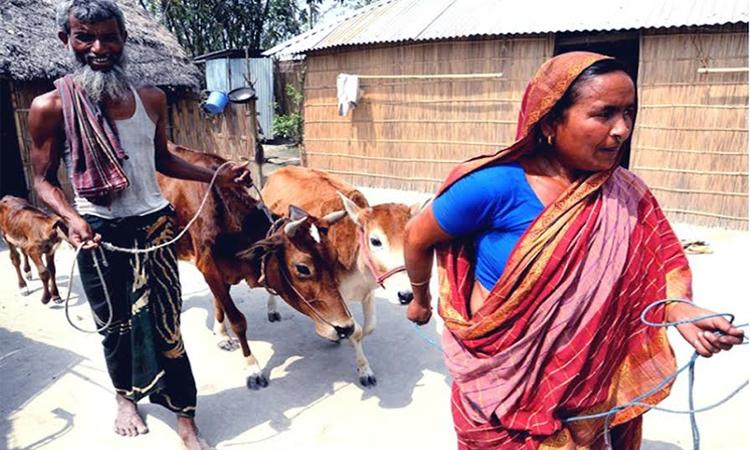
RANGPUR, Jan 26, 2026 (BSS) - The growing development of the livestock sector at the household level has brightened the fortunes of hundreds of people living in the riverine chars and riparian areas of the Brahmaputra basin in recent years.
Many char people have achieved self-reliance by raising cows, goats, sheep and poultry in the sandy char areas.
Earlier, they had relied mainly on relief materials during the dry season and floods for decades, and were struggling to survive.
According to local people and experts, the livestock sector has been a boon for improving the living standards of char people since the implementation of the 12-year (2004-2016) Comprehensive Char Livelihood Programme (CLP) in 10 northern districts.
Under the programme, extremely poor households of Kurigram, Bogura, Gaibandha, Sirajganj, Jamalpur, Lalmonirhat, Nilphamari, Rangpur, Pabna and Tangail districts received assistance to successfully boost the livestock sector at the family level.
In addition to animal husbandry, the people of chars and riparian areas conducted other income-generating activities (IGAs) with CLP and other GO-NGO assistance and achieved success for a better life by improving their socio-economic conditions.
The UK aid through the Department for International Development (DFID), Australian Government through the Australian Agency for International Development (AusAID) and the Government of Bangladesh funded the completion of CLP implementation by 2016.
The comprehensive CLP activities eradicate extreme poverty of the have-nots group households through animal husbandry and various IGAs to improve their livelihoods, life standard and change socioeconomic conditions.
Talking to BSS, Chairman of North Bengal Institute of Development Studies Dr Syed Samsuzzaman said the multidimensional CLP activities were implemented by local partner NGOs in the riverine char islands to achieve the goals.
The CLP worked with extremely poor char households to improve livelihoods through providing package support for animal husbandry, assets and raising plinths for income-generating activities under adverse climatic situations.
Md Mamunur Rashid, a PhD Fellow in the Department of Agricultural Extension at Haji Mohammad Danesh University of Science and Technology, said the animal husbandry sector continues expanding fast on char areas bringing fortune to char people.
Char people are reaping better profits from selling cattle-heads after fattening, increasing meat and milk production, meeting nutritional demand of malnourished children and fodder crisis by cultivating grass in vast char areas.
"Many extremely poor char families have achieved self-reliance through animal husbandry alongside other income generation activities with CLP assistance since 2016 to lead better lives now along with their children," he said.
Talking to BSS, a couple, Fancy Begum and Shahinur Islam of Char Purbo Mohipur in Gangachara upazila of Rangpur said they have been rearing cows, goats and calves in recent years and earning enough to lead a better life.
Anwar Hossain, Mozammel Haque, Nur Islam and Mahbub Alam of nearby village Char Paschim Mohipur also narrated their success stories of winning poverty through rearing cattle heads in recent years.
Farmers Aminul Islam, Noor Nahar, Parul Begum and Aklima Khatun of village Char Taluk Shahbaz in Balapara union of Kawnia upazila in Rangpur said they expect to sell their three to eight healthier bulls at Taka 1.50 lakh for each.
Char people Abdus Sabur, Lokman Hossain, Habibur Rahman and Morshed Hossain of Char Machabandha village in Chilmari upazila of Kurigram said they are expecting to sell their 10 healthier bulls, at between Taka 90,000 and 140,000 each, soon.
Char dweller Abdul Ahad of Astomirchar in Chilmari upazila in Kurigram said he recently sold his six Black Bengal goats for Taka 1,15,000 and seven sheep for Taka 65,000 after purchasing those together for Taka 65,000 last year.
Rangpur District Livestock Officer Dr Md Abu Sayeed told BSS that char residents, mostly landless and affected by river erosion, are now raising animals on a commercial basis in the vast sandy char areas, and changing their fortunes successfully.